Brainerd Web Design
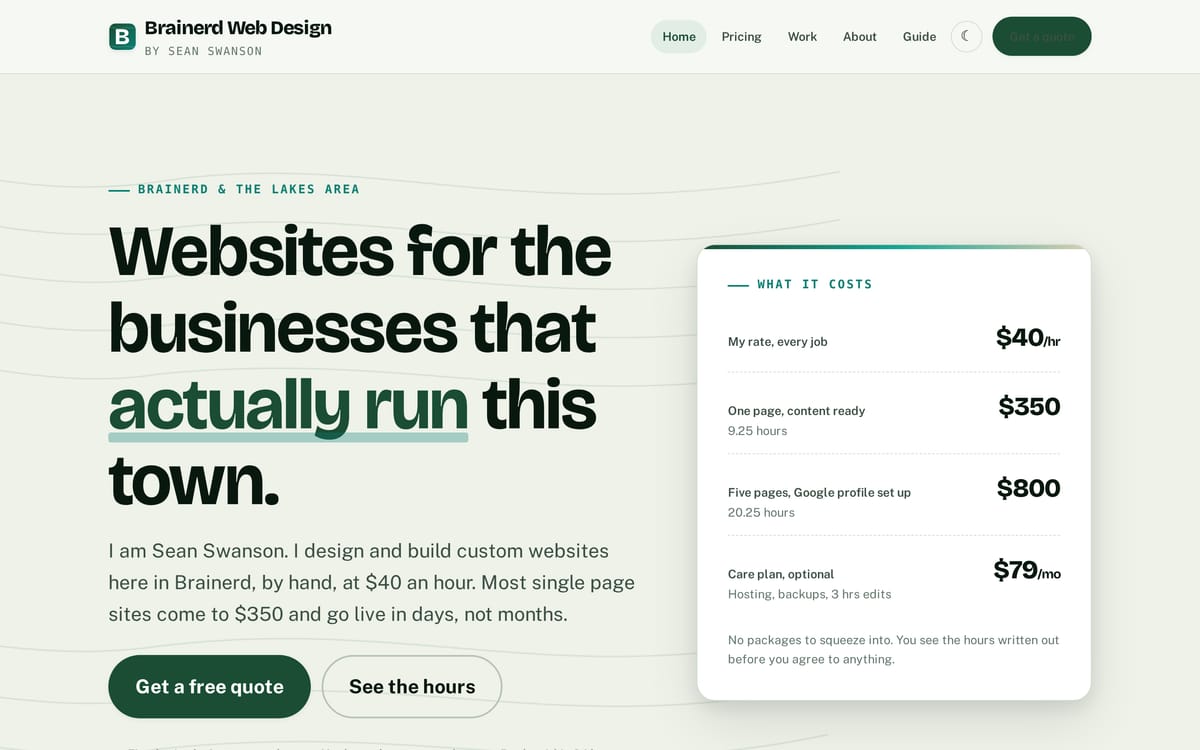
Most web designers have one site and hope it ranks everywhere. I built a second one that only tries to rank for a single town, and made it look like nothing else I have built.
Why a second site at all
Somebody in Brainerd looking for a web designer does not search the way somebody in Minneapolis does. They type the town name. They want to know what it costs before they call. And a page listing forty service areas reads to them as a company that is not really here.
So this is not a landing page bolted onto my main site. Its own domain, its own design, its own words, aimed at one market. A page that talks to one town beats a page that mentions thirty.
What is actually on it
Six pages: home, pricing, work, about, a plain-English guide, and contact.
The pricing page is the point of the whole thing. The price is on it, from $595 for a one-page site up to $1,495 for a full custom build, with what decides it written out rather than boiled down into packages.
That matters because the most common reason a small business owner never calls a designer is simple. They have no idea whether the answer is $400 or $4,000.
The guide is for people who are not ready to hire anybody. It answers the questions I get asked on the phone, in the order I get asked them.
Built to look like nothing else I own
This is the part that took the real work. It shares no stylesheet, no class names and no components with my main site.
Pine green and lake aqua instead of bone and navy. Bricolage Grotesque instead of Instrument Serif. A contour-line motif instead of flat panels. Its own light and dark themes.
That is deliberate, and it is not just for looks. A group of local sites that are one template with the town name swapped is obvious to anyone who opens two of them. I would rather build the second design than explain the shortcut. If I build a third, I will draw a third design rather than reuse this one with new settings.
The unglamorous parts
The whole site is static files, made by a small Python script with no dependencies at all. Six source fragments go in. Six pages and a sitemap come out. Nothing to update, nothing to get exploited, and it deploys from a push.
The contact form was the fiddly bit. On my main site, notifications were landing in Spam. The message quoted a stranger’s text and carried a stranger’s reply address, on mail sent from my own domain. That is exactly what a phishing attempt looks like.
This form does not do that. It carries a fixed subject tag and its own header instead, so the notification is easy to spot no matter what somebody types into it.
What I cannot tell you yet
Whether it works.
It went live in August 2026, and local search results take months. Any number I put here would be invented. When it has ranked, or failed to, this paragraph gets rewritten with the real outcome.