BrandForge
The creative part of a logo is the short part. The hours go on everything after it. This app does both, on my machine, with keys I already pay for.
The problem
A small business needs more than a logo. It needs the favicon set. The social avatars and headers. A business card. A letterhead. The palette in whatever format the next developer asks for. And a page that explains how to use all of it.
The creative part is quick. Making all of that afterwards is hours of repeat export work.
No single AI image model is best at everything, either. One is strongest at type. One returns real vector SVG. One is best at editing with a reference image. One is best at drawn marks. Using them well means juggling several dashboards, prompts and file formats.
And the web tools that promise to fix this keep your client’s files on someone else’s server, then charge per seat.
A brand designer, not a prompt box
The assistant is Claude, with a set of tools it can use on the project. It can update the brief, set the palette and fonts, make logos through a chosen provider, look at what came back and critique it, make variants, vectorize, cut out backgrounds, write an SVG logo directly, set the master logo, and build the kit.
It is briefed as a designer. It writes prompts the way a designer briefs a renderer. And it knows which model suits which job: type goes to Ideogram, vector marks to Recraft, drawn mascots to FLUX.
Six providers sit behind one screen: OpenAI GPT Image, Google Gemini, Recraft, Ideogram, Black Forest Labs FLUX and Stability. I add only the keys I have, and the app works with whatever is set up.
A workflow, not a chat
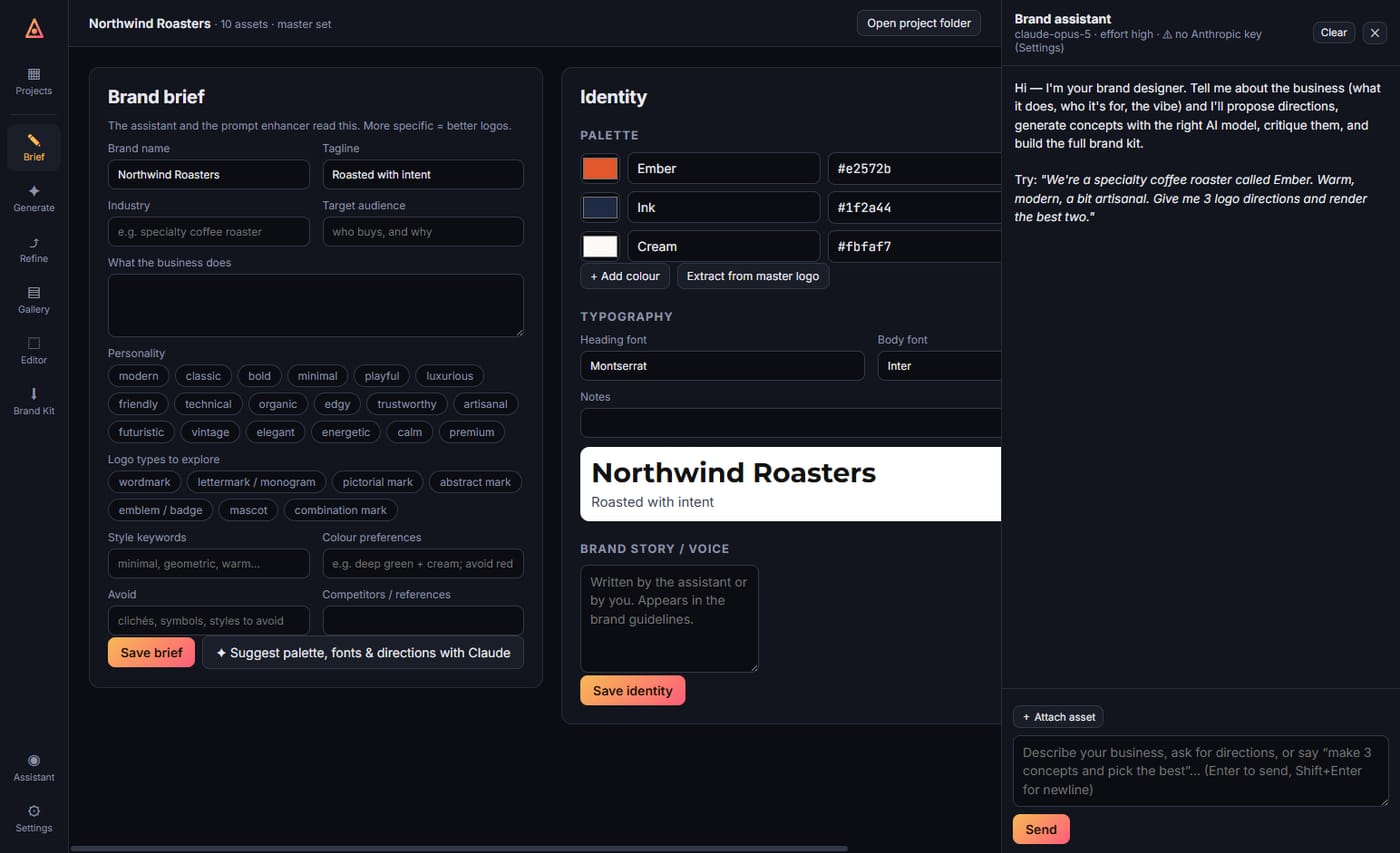
First a project, then a brief: the business, its audience, its personality, the logo types to try, style words, and things to avoid.
Then generate. Through the assistant, or by hand with a provider. There is prompt enhancement, style presets, aspect, transparency, palette steering and reference images. To refine, drop in a sketch and run image-to-image with any provider.
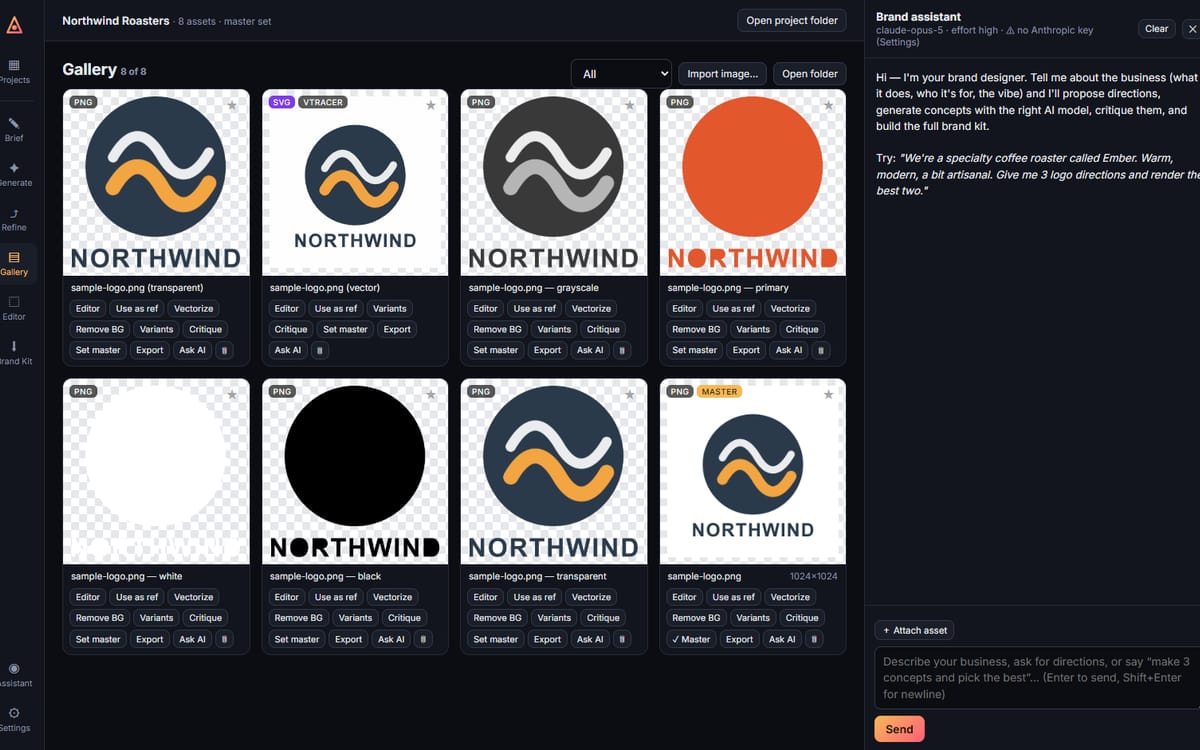
The gallery is where the work gets sorted. Favorite it. Vectorize it. Cut the background. Make mono, white and black variants. Ask for a critique. Export as PNG, JPG, WEBP, ICO or SVG.
From there it goes to the editor, and then to the kit.
The editor is a real canvas, built on fabric.js. Text in more than sixty Google Fonts plus your system fonts. Shapes, imported files and SVGs. Layers. Undo and redo. Palette swatches. Export straight back into the gallery as PNG or SVG.
One click, one kit
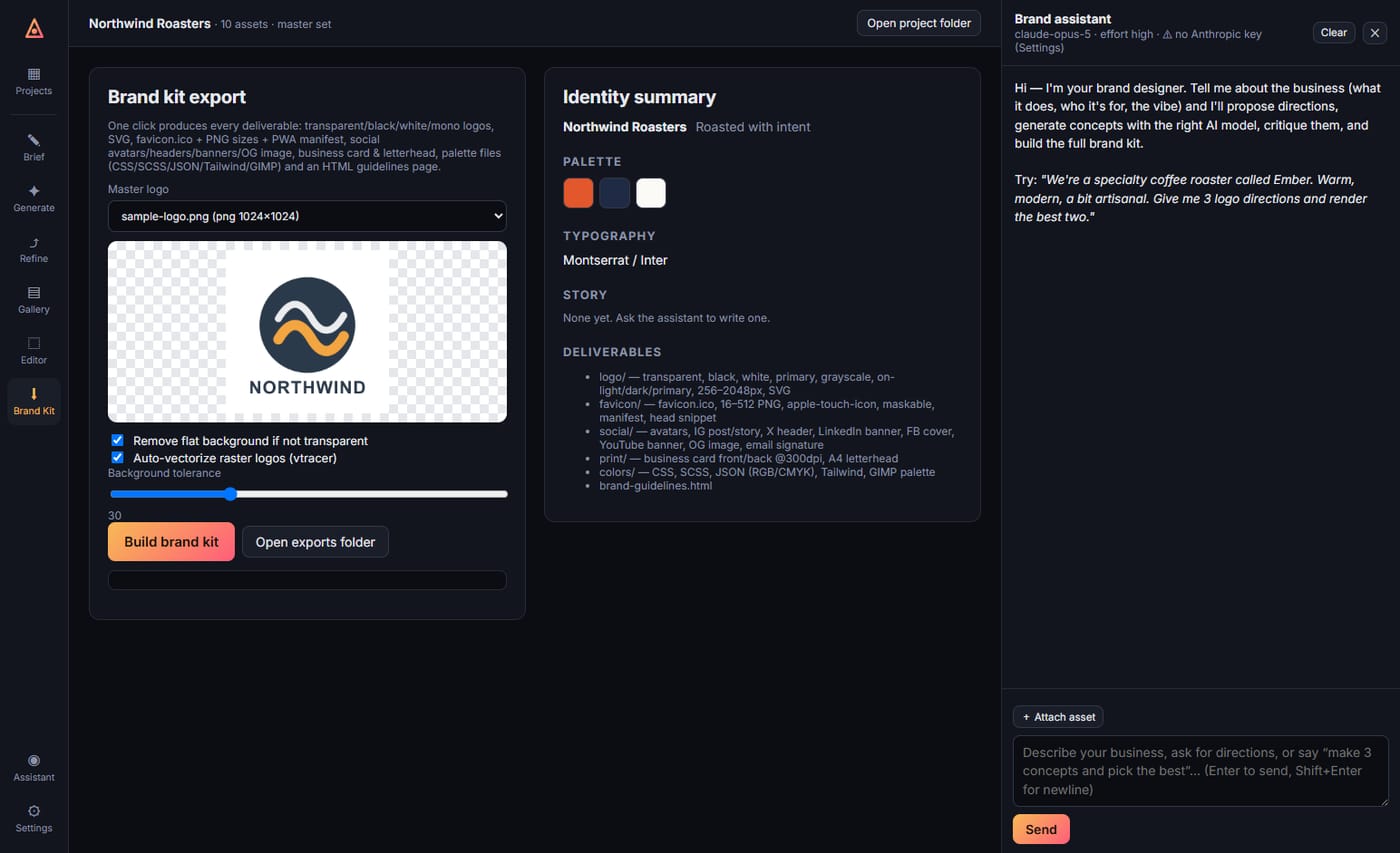
The kit builds transparent, black, white, primary and grayscale logos. An SVG. A favicon.ico with PNGs from 16 to 512 pixels. An apple-touch icon and a PWA manifest. Social avatars, headers, banners and an OG image. A business card and letterhead at 300 dpi. The palette as CSS, SCSS, JSON, Tailwind and GIMP files. And a brand guidelines page.
The local image work runs through sharp and a local vectorizer. Variants, vectorizing, background removal, resizing. None of it costs a provider call.
Local and private
API keys are encrypted with Windows DPAPI and stored per user. Environment variables work too. Projects, files and exports live in a local Documents workspace. Nothing leaves the machine except the generation requests themselves.
Shipped as a real app
Packaged with electron-builder into an NSIS installer. It gets an Add or Remove Programs entry, Start Menu and desktop shortcuts, and its own icon.
The app carries a keyless end-to-end self-test that drives the real screen. Create a project. Import a mark. Make variants. Export from the editor. Build the kit. So a packaging change can be checked without spending a single API call.
That self-test made the screenshots on this page. It imported one sample mark for an invented coffee roaster, produced eight gallery files, and built a 49-file kit in about a second. No API keys were set up, so nothing in the pictures is generated output.
Where it landed
Version 1.0.0 was packaged and installed on 1 September 2026. It is my own tool. I use it for my own branding work and it is not for sale.
About 3,900 lines of plain JavaScript across the main process, the providers, the image work, the brand kit, the assistant, the renderer and the editor. No framework, no bundler.
A closer look