SiteParamedic
Most small businesses have no way to tell whether the website they paid for is any good. SiteParamedic gives them a straight answer, in plain words, and a fixed price to put it right.
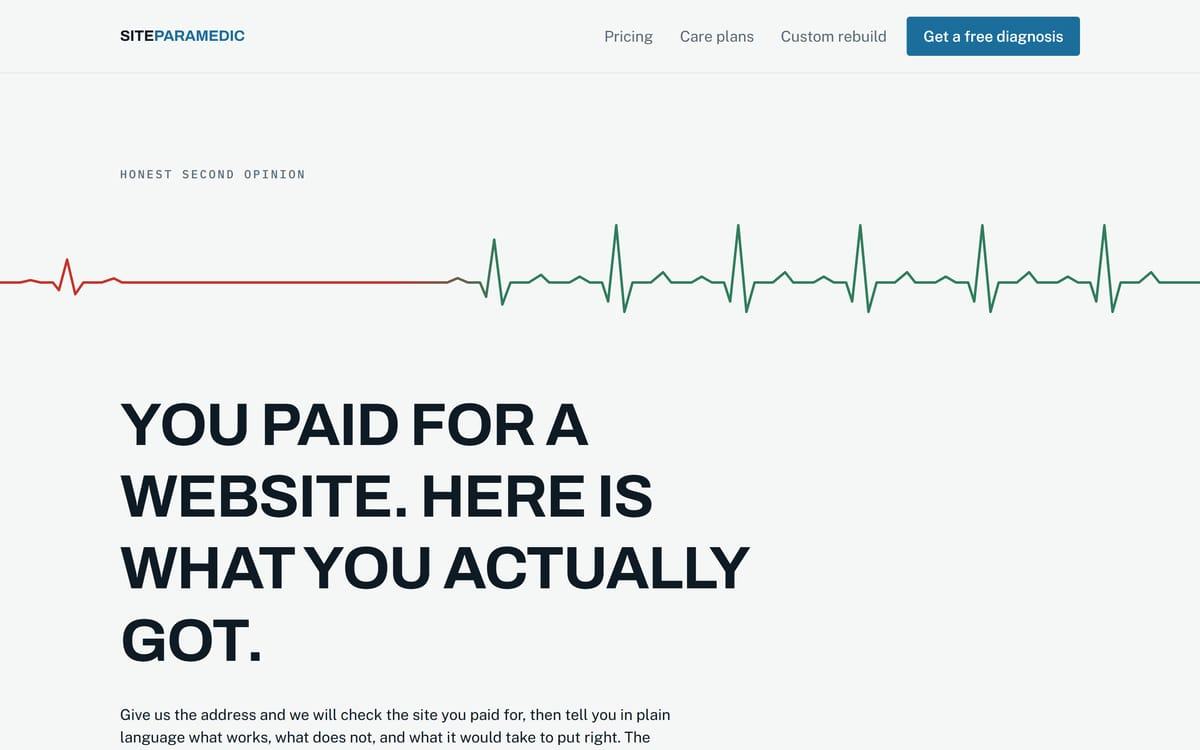
The problem
Someone pays an agency for a website. A year later it feels slow and the phone is not ringing.
They have no way to work out whether that is the site or the market. The people who built it are not going to volunteer that it is broken. And a score out of a hundred means nothing to a person who runs a landscaping company.
So they either live with it, or pay somebody else and hope. Both are bad, and both happen because there is no honest second opinion at a price a small business will pay.
What I built
Hand over the address. The site checks what you paid for and reports back in words a business owner can act on. What works, what does not, and what it would take to fix.
The check is free, because the report is the pitch.
From there the routes are fixed price. Single repairs for a site worth saving. Care plans for the ones that need watching. A full rebuild for the ones that are past it. Nothing starts without the price agreed first.
How it holds together
Next.js on the front, Convex behind it, Stripe for checkout and plans, Resend for mail.
Development and production are pinned to separate Stripe modes, so local work physically cannot charge a real card.
That split exists because of a real near miss. I once built production from the local settings file, which pointed the live site at the development backend and its test keys. Every page still returned 200. Nothing looked wrong anywhere. Checkout had simply and silently stopped being able to take money.
The only reliable way to catch that is to read the backend address out of the built JavaScript. Loading the page and seeing that it works tells you nothing.